
Introduction
BiPAP machines are commonly used for non-invasive respiratory support. They deliver pressurized air through a mask to help support breathing. However, choosing the correct BiPAP mask is just as important as selecting a compatible machine.
There are different types of BiPAP masks available, including vented BiPAP masks, non-vented BiPAP masks, and masks with an exhalation port or special connector.
Many people think that vented and non-vented masks differ only in their appearance. In reality, the main difference is how exhaled carbon dioxide (CO₂) is removed from the breathing system.
Using an incompatible mask and breathing circuit combination may result in inadequate ventilation and CO₂ rebreathing.
In this guide, we will explain:
- What is a vented BiPAP mask?
- What is a non-vented BiPAP mask?
- Difference between vented and non-vented masks
- How exhalation ports work
- Mask and circuit compatibility
- Common mask types and components
- Frequently asked questions
What Is a BiPAP Mask?
A BiPAP mask is an interface that connects a patient to a BiPAP or compatible non-invasive ventilation machine.
BiPAP stands for Bilevel Positive Airway Pressure. Unlike conventional CPAP, which provides one continuous pressure, BiPAP delivers two pressure levels:
- IPAP (Inspiratory Positive Airway Pressure): Higher pressure during inhalation.
- EPAP (Expiratory Positive Airway Pressure): Lower pressure during exhalation.
The difference between these pressures is called pressure support.
A BiPAP mask helps deliver the prescribed airflow while maintaining a suitable seal around the nose or nose and mouth.
Common mask styles include:
- Nasal BiPAP Mask
- Full Face BiPAP Mask
- Oronasal Mask
- Nasal Pillow Mask
- Vented BiPAP Mask
- Non-Vented BiPAP Mask
Vented and non-vented refer to the exhalation design, whereas nasal and full-face refer to the mask's physical shape.
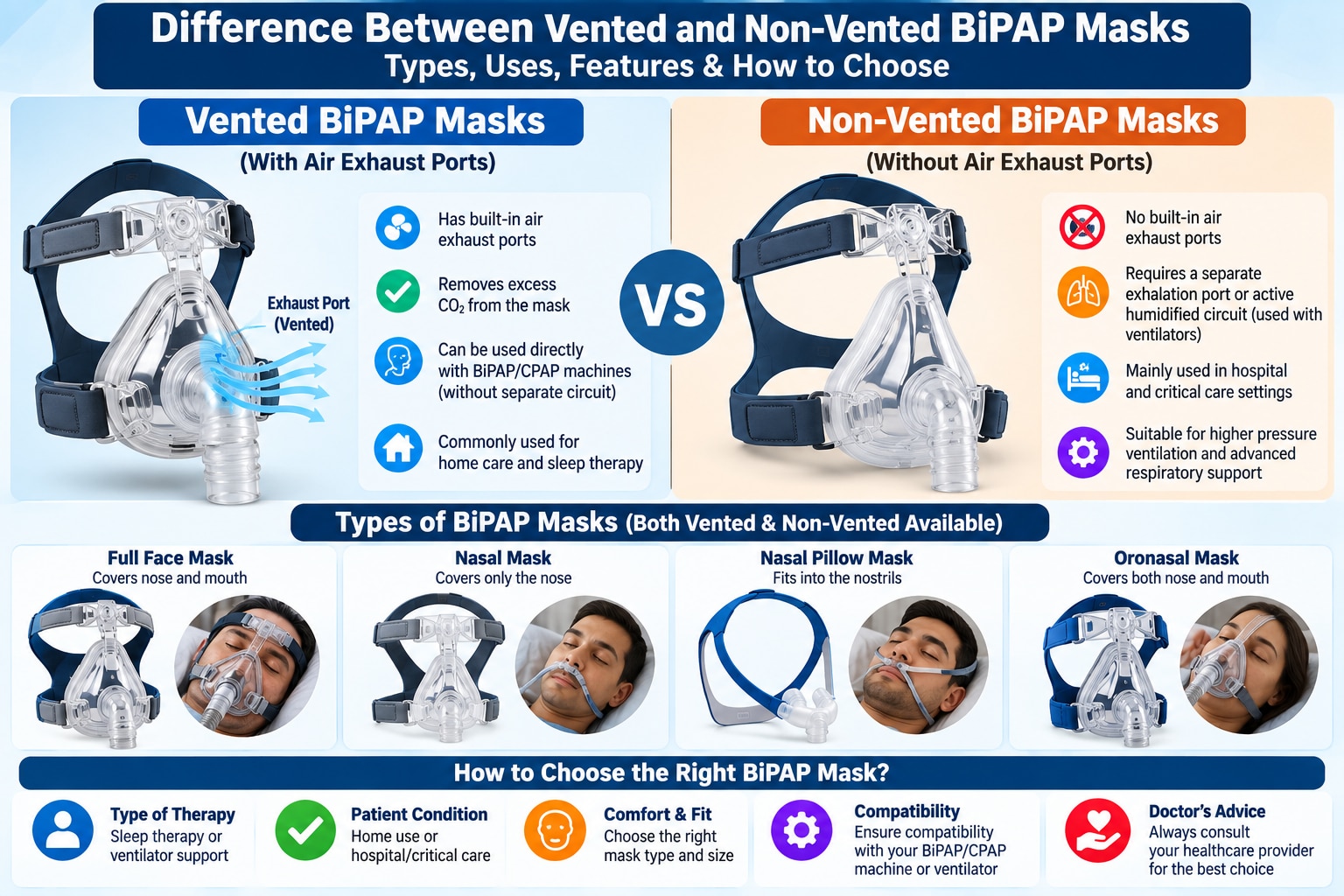
What Is a Vented BiPAP Mask?
A vented BiPAP mask has small holes or a specially designed leak port that allows exhaled air, including carbon dioxide, to escape from the breathing system.
These openings are called exhalation ports or intentional leak ports.
During inhalation, the machine delivers pressurized air through the mask. During exhalation, the vent allows expired gases to escape.
Key Features of Vented BiPAP Masks
- Built-in exhalation holes or leak port
- Supports CO₂ clearance when used with a compatible circuit
- Commonly used with single-limb passive-leak circuits
- Available in nasal and full-face designs
- Available in different sizes and configurations
- Designed for use with compatible BiPAP or NIV devices
How Does a Vented Mask Work?
A vented mask works through a controlled leak system.
When the patient exhales, some air exits through the mask's intentional leak port. The machine's airflow and the designed leak help wash expired CO₂ away from the mask and circuit.
The vent is not a manufacturing defect. It is an important part of the mask's ventilation design.
Where Are Vented Masks Used?
Vented masks are commonly used with compatible home BiPAP systems and single-limb NIV circuits designed for intentional leak.
However, the mask must match the machine and circuit configuration. Not every vented mask is suitable for every ventilator.
What Is a Non-Vented BiPAP Mask?
A non-vented BiPAP mask does not have built-in exhalation holes or an intentional leak port.
It relies on an external exhalation mechanism within the breathing circuit to remove carbon dioxide.
This mechanism may be:
- An active exhalation valve
- A dedicated expiratory limb in a dual-limb circuit
- A compatible circuit-based leak or exhalation system
Non-vented masks are commonly used in hospital NIV setups and with compatible ventilators.
Key Features of Non-Vented BiPAP Masks
- No built-in intentional exhalation port
- Requires a compatible external CO₂ removal system
- Available in nasal and full-face designs
- May include an anti-asphyxia valve depending on model
- Used with compatible single-limb or dual-limb circuits
- Designed for specific ventilator configurations
How Does a Non-Vented Mask Work?
In a non-vented mask setup, exhaled air travels through the breathing circuit and is removed by the circuit's exhalation system.
The mask itself does not provide the required CO₂ washout.
This is why selecting the correct circuit, exhalation valve and mask combination is essential.
Important: A non-vented mask must never be used with a circuit that lacks an appropriate exhalation mechanism.
Difference Between Vented and Non-Vented BiPAP Masks
Feature | Vented BiPAP Mask | Non-Vented BiPAP Mask |
Exhalation holes | Present | Absent |
CO₂ removal
| Through intentional leak port
| Through external circuit mechanism
|
Common setup
| Single-limb passive-leak circuit
| Compatible active-valve or dual-limb circuit
|
Circuit dependency
| Requires matching leak configuration
| Requires dedicated exhalation mechanism
|
Mask elbow
| Designed with venting
| Usually without venting
|
Common use
| Compatible home NIV/BiPAP setups
| Hospital NIV and compatible ventilator setups
|
Compatibility
| Must match machine and circuit
| Must match machine and circuit
|
Main consideration
| Correct leak and airflow | Correct external exhalation pathway |
The biggest difference is the location of the CO₂ removal mechanism.
In a vented mask, the mask has the intentional leak port. In a non-vented mask, the breathing circuit must provide the required exhalation pathway.
Vented vs Non-Vented BiPAP Mask: Understanding the Exhalation Port
An exhalation port is a specially designed opening that allows expired air to leave the breathing system.
In a vented mask, this port is built into the mask or its connector.
In a non-vented mask, the exhalation pathway is provided elsewhere in the circuit.
Why Is the Exhalation Port Important?
During breathing, the patient exhales carbon dioxide. If the expired air is not adequately removed, CO₂ may accumulate in the mask or circuit.
This can cause CO₂ rebreathing and inadequate ventilation.
Therefore, the mask, tubing, ventilator and exhalation system must work together as a complete setup.
What Is the Difference Between a Vented and Non-Vented Mask Elbow?
The elbow is the connector that joins the mask to the breathing tube.
Some mask models have different elbow configurations.
Vented Elbow
- Includes an intentional leak opening.
- Allows expired air to escape.
- Designed for compatible passive-leak circuits.
Non-Vented Elbow
- Does not have an intentional leak opening.
- Depends on an external exhalation mechanism.
- May be designed for use with a ventilator circuit.
Some manufacturers offer interchangeable elbows or adapters. However, not all masks have this feature.
Never modify or interchange mask elbows unless the manufacturer specifically permits it and the complete setup has been verified by a qualified professional.
What Is an Anti-Asphyxia Valve in a BiPAP Mask?
An anti-asphyxia valve is a safety feature found in certain non-vented mask designs.
It is intended to allow the patient to breathe ambient air if the machine stops supplying adequate airflow, according to the mask's design.
However, an anti-asphyxia valve is not a replacement for the required CO₂ exhalation system during normal ventilation.
The presence or absence of this valve depends on the mask model and intended circuit configuration.
Types of BiPAP Masks Available
1. Vented Full Face BiPAP Mask
A vented full-face mask covers both the nose and mouth.
It includes an intentional leak port for exhaled air and is designed for compatible BiPAP systems.
2. Non-Vented Full Face BiPAP Mask
A non-vented full-face mask covers the nose and mouth but does not have a built-in exhalation port.
It is used with a compatible circuit that provides CO₂ removal.
3. Vented Nasal BiPAP Mask
A nasal mask covers the nose and delivers pressurized air through the nasal interface.
It includes a designed leak port and is available in compatible configurations.
4. Non-Vented Nasal Mask
A non-vented nasal mask does not have an intentional leak port and requires a compatible external exhalation system.
5. Vented Mask with Special Connector
Some mask configurations include a vented elbow or connector designed to provide intentional leak.
Always check the manufacturer's product information before selecting the connector.
How to Choose the Correct BiPAP Mask?
Choosing a BiPAP mask involves more than checking whether it is vented or non-vented.
The following factors should be considered.
1. Check the BiPAP Machine Model
Different machines support different circuit configurations.
Check the manufacturer's compatibility information for the exact device.
2. Identify the Breathing Circuit
Confirm whether the system uses:
- Single-limb passive-leak circuit
- Single-limb circuit with an active exhalation valve
- Dual-limb circuit
3. Check the Exhalation Mechanism
Confirm where the exhaled air and CO₂ are intended to leave the circuit.
4. Select the Correct Mask Size
A mask that is too large or too small may cause air leakage, discomfort or pressure-related skin irritation.
5. Consider Patient Comfort
The cushion material, headgear, mask shape and contact points influence comfort and tolerance.
6. Confirm Manufacturer Compatibility
Always follow the machine and mask manufacturer's instructions.
The final selection should be made by a respiratory therapist, clinician or qualified equipment professional familiar with the prescribed ventilation setup.
Common Problems With BiPAP Masks
1. Air Leakage
Air may leak around the nose, cheeks or mask cushion.
Possible reasons include incorrect size, poor positioning or worn components.
2. Skin Irritation
Continuous pressure around the nasal bridge or face may cause discomfort or skin irritation.
Correct sizing and regular skin checks are important.
3. Excessive Leak
An unintended leak may affect pressure delivery and machine performance.
The mask fit and circuit should be checked.
4. Incorrect Mask and Circuit Combination
Using an incompatible vented or non-vented mask can interfere with CO₂ clearance.
Always verify compatibility before use.
5. Difficulty Breathing or Discomfort
If a patient experiences worsening breathlessness, unusual drowsiness, confusion or significant discomfort while using NIV, seek urgent medical assessment.
Frequently Asked Questions (FAQs)
1. What is the main difference between vented and non-vented BiPAP masks?
A vented mask has an intentional exhalation port to allow expired air and CO₂ to escape. A non-vented mask has no built-in leak port and relies on an external exhalation mechanism in the circuit.
2. Can I use a non-vented BiPAP mask with a normal BiPAP machine?
Not automatically. Compatibility depends on the machine, circuit and exhalation system. A non-vented mask must be used only with a setup designed to remove exhaled CO₂.
3. Can I use a vented mask with a ventilator?
Only if the ventilator and circuit are specifically designed and approved for that mask configuration. Some ventilators use dedicated expiratory limbs or valves, so mask selection must follow manufacturer instructions.
4. Is a vented BiPAP mask better than a non-vented mask?
Neither is universally better. They are designed for different circuit configurations. The correct option depends on the prescribed therapy, device and breathing circuit.
5. What is a BiPAP mask with an exhalation port?
It is a mask with a designed opening that allows exhaled air to escape. This is generally a vented mask.
6. What happens if a non-vented mask is used without an exhalation valve?
The patient may rebreathe exhaled CO₂, creating a potentially dangerous situation. The correct exhalation system must always be present.
7. Are vented and non-vented masks available in full-face designs?
Yes. Both types are available in different mask designs, depending on the manufacturer and model.
8. Can a vented mask be converted into a non-vented mask?
Some manufacturers offer interchangeable elbows or adapters, but this is not universal. Only use manufacturer-approved configurations.
9. What is the difference between CPAP and BiPAP masks?
The terms CPAP and BiPAP describe different pressure-delivery therapies. Mask compatibility depends on the device and circuit design, not simply on the name of the therapy.
10. Where can I buy BiPAP masks in Gurgaon?
Medimish Healthcare Solutions offers BiPAP mask options, including vented and non-vented types, subject to model and stock availability.
Buy Vented & Non-Vented BiPAP Masks in Gurgaon
Looking for a BiPAP Mask in Gurgaon or Gurugram?
Medimish Healthcare Solutions offers respiratory equipment and accessories for home care and healthcare facilities.
Available Mask Options
- Vented BiPAP Mask
- Non-Vented BiPAP Mask
- Vented Mask with Exhalation Port
- Full Face BiPAP Mask
- Nasal BiPAP Mask
- BiPAP Mask Accessories
We can help you check product type, model, size and compatibility information.
Contact Medimish Healthcare Solutions for BiPAP Mask Price, Availability and Product Details.
Website: https://www.medimish.in
Location: Gurgaon/Gurugram, Haryana